
Careers and Guidance for Parents and Carers
At KNGS, we believe that the choices young people make throughout their school journey shape not only their future careers but also their personal fulfilment and happiness. Guided by our values of ambition and resilience, we encourage pupils to explore opportunities that inspire them to aim high and make informed decisions. Many of the resources provided also include sections for parents and carers, supporting them in helping their children navigate these important steps with confidence and care.
Labour Market Information
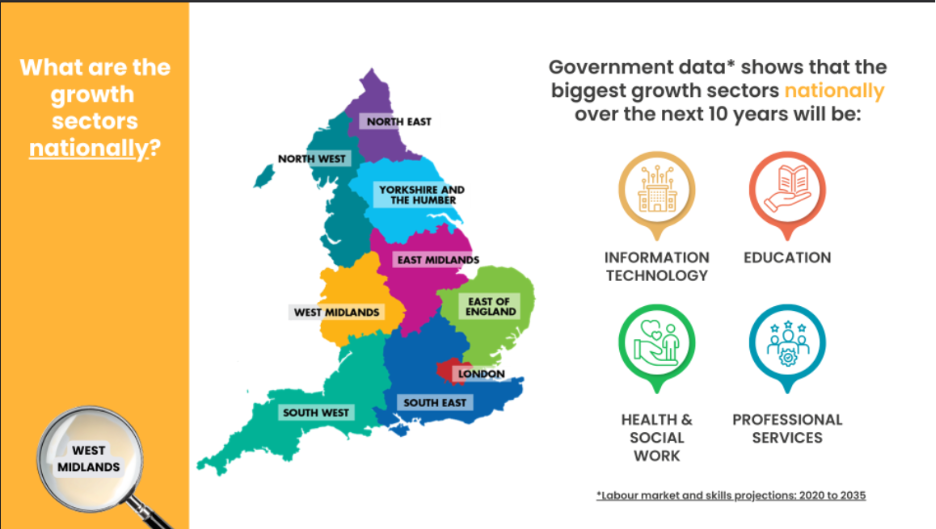
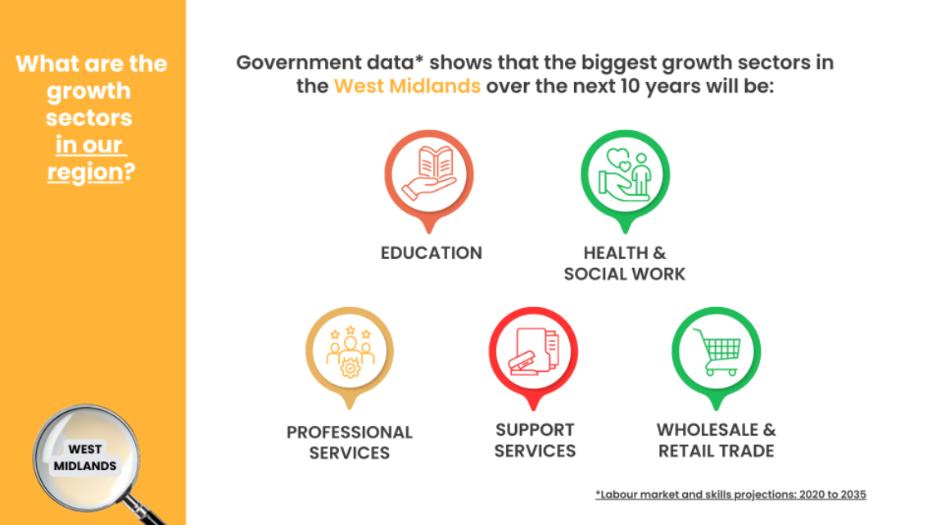
Largest employers in the area
NHS, Asda, Sainsburys , Jaguar Landrover, Mondelez International, Whitbread, Specialist Computer Centres (SCC) and the University of Birmingham.
These companies need Engineers, Designers, Doctors, Nurses and Academics.
In fact there are over 350 different NHS Careers to choose from, whatever your qualifications, skills and interests.
Don’t forget too, that all large companies, whatever their industry, need qualified staff to work in Sales, Finance, Marketing, Buying, IT, Customer Service, Administration and Management
Average Salary
£35,000
Construction & Skilled Trades
Roles: Bricklayers, electricians, plumbers, carpenters, roofers, scaffolders.
Why in demand: Infrastructure expansion, aging workforce, and fewer apprentices.
Hospitality & Tourism
Roles: Chefs (especially in Indian, Chinese, and Italian cuisine), hotel staff, bartenders, waiters
Why in demand: Post-COVID tourism boom and Brexit-related labour gaps.
Logistics & Transport
Roles: HGV drivers, warehouse operatives, delivery drivers.
Why in demand: E-commerce growth and supply chain disruptions
Healthcare
Roles: Nurses, care workers, paramedics, radiographers, and support staff.
Why in demand: NHS staffing shortages, aging population, and post-pandemic strain.
Agriculture & Horticulture
Roles: Fruit/vegetable pickers, dairy assistants, greenhouse workers, tractor drivers.
Why in demand: Seasonal labour shortages and reduced EU workforce
Technology & IT
Roles: Software developers, cybersecurity analysts, data scientists, IT support.
Why in demand: Digital transformation across industries

ICould – watch videos linked to job roles, with LMI under each clip
U-Explore explore different job roles with LMI included
Skills for Careers Start thinking about skills and training for your career
Career Pilot – job roles with LMI included
Eclips – ask your Birmingham Careers Service Adviser to show you LMI for your chosen careers
Shaping Futures a collection of resources to help you explore LMI
Online Career Resources
Aimhigher West Midlands is a partnership of Higher Education Institutions (HEIs), schools, academies and colleges. Together, they want to make sure that young people from less advantaged backgrounds have access to high quality, exciting and challenging experiences that enhance their careers education, motivate, inspire and provide accurate and impartial information, advice and guidance about higher education.
There are some really helpful sections on this website that cover most areas relating to progression – aimhigherwm.ac.uk/resource-bank – this link will take you to what you need to know for each key stage and there is also a helpful parent area. The KS3 & KS4 learners area covers everything from choosing GCSE options; Journey to Higher Education; Careers of the Future – West Midlands and the Post 16 Learners area has information on how to choose subjects; student finance and many other age related topics.
The National Career Service provide information, advice and guidance to help you make decisions on learning, training and work. The National Careers website as information on exploring careers; skills assessment; finding a course and help to get a job. There is a web chat facility for you to ask questions and you can also telephone them on 0800 100 900.
Website that gives you free access to more than a thousand videos related to different curriculum subjects of people telling their personal careers stories in their own words including information on Labour Market Information (LMI) e.g. average salary, skills & qualification.
Success at School is the place for young people to explore careers, get the lowdown on top employers, and search for the latest jobs, courses and advice. Lots of helpful advice in the advice section on employability skills, work experience, apprenticeships, university and different career paths. Information for parents can be found in the advice section. There are some excellent subject handouts that gives details of the where the subject can lead you which you can download now. You will need to sign up to access these resources and the subject resources can also be found on Firefly – go to the Careers section and select number 3 – Linking Curriculum to Careers.
Expert careers information and tools for 11-19 year olds, all in one place. Do you love a subject and wonder where it might lead you – you will find this link helpful – careerpilot.org.uk/job-sectors/subjects
Unifrog
At KNGS, Unifrog is embedded throughout our Careers Programme and delivered as part of PSHE lessons. It supports students in discovering their future pathways—from selecting GCSE subjects to exploring post‑18 options such as university, apprenticeships, or employment. Reflecting our values of ambition and resilience, Unifrog empowers students to take ownership of their journey by bringing all available information into one impartial, user‑friendly platform. This enables them to make informed decisions, showcase their strengths, and submit the most competitive applications with confidence and respect for their individual aspirations.
- Key stage 3 launch (choosing GCSEs)
- Key stage 4 launch (choosing post 16 pathways)
- Key stage 5 launch (choosing post 18 pathways)
University Access Programmes
University Access Programmes are designed and delivered by universities and help year 12 students make informed choices about their future; equipping them with the knowledge, experience and skills needed to be successful in accessing higher education.
At KNGS, University Access Programmes are completed alongside A Level studies and aim to help Year 12 students, who meet specific criteria, gain a place at university, and include a mixture of online and on-campus events, workshops, academic assignments and academic mentoring.
Pathways to the Professions Programmes – (Healthcare, Business, Law, STEM)
Pathways to Birmingham Programme (Inspired, Routes to the Professions, Academic Enrichment Programme and Access to Birmingham – A2B – year 13 only)
(15 x Russell Group – RIUs research intensive universities – a unique collaboration of leading research universities from across the UK working together to promote fair access to university and professions)
(Warwick Scholars, Pathways to Professions, Realising Opportunities)
University Summer Schools and Employer Internships
University summer schools give Year 12 students the chance to experience university life first‑hand. These short, structured programmes- usually held during the summer term—allow students to explore academic subjects, meet lecturers and current students, and gain confidence about their next steps after Sixth Form.
Internships help students gain first-hand experience with top employers and develop the skills needed to achieve their aspirations.
Social Mobility Foundation – (internships with top employers)
The Sutton Trust Summer School – (UK university summer schools)
UNIQ – University of Oxford Summer School – (university summer school)
Quick Guide to Qualifications
Level 2 qualifications are equivalent to GCSEs at grades 4–9 and provide a solid foundation for further study or employment. They focus on developing essential knowledge, skills, and understanding in a specific subject or vocational area.
Examples include GCSEs, BTEC Level 2 Diplomas, NVQs, and T Level Foundation Programmes. These qualifications help students build confidence and prepare for progression to Level 3 courses, such as A Levels, BTEC Extended Diplomas, or apprenticeships.
Students must achieve a Level 2 pass in English Language and maths to progress onto Level 3 study.
Level 3 qualifications are advanced courses typically studied by students aged 16 and over after completing Level 2 (GCSE‑equivalent) studies. They provide the knowledge, skills, and understanding needed for progression to university, higher apprenticeships, or skilled employment.
Examples include A Levels, BTEC Extended Diplomas, T Levels, and NVQ Level 3 qualifications. These programmes encourage independent learning, critical thinking, and practical application of knowledge.
Level 4 qualifications are advanced courses studied after completing Level 3 (A Level, BTEC, or T Level) programmes. They represent the first stage of higher education and focus on developing specialist knowledge and professional skills within a chosen field.
Examples include Higher National Certificates (HNCs), Level 4 Apprenticeships, and the first year of a university degree. These qualifications prepare students for progression to Level 5 and above, or for entry into skilled employment.
A Levels (Advanced Levels) are two‑year academic qualifications typically studied by students aged 16 to 18 after GCSEs. They focus on in‑depth subject knowledge and are assessed mainly through written examinations at the end of Year 13. Students usually choose three A Level subjects, allowing them to specialise in areas that reflect their interests and future ambitions. A Levels are highly valued by universities, employers, and apprenticeship providers because they develop critical thinking, independent study, and analytical skills.
At KNGS, we encourage students to select subjects that align with their strengths and aspirations, supporting them to achieve ambitious goals and progress confidently to higher education, training, or employment. We only offer advanced level study at Kings Norton Sixth.
T Levels | The Next Level Qualification
T Levels are two‑year technical qualifications for students aged 16 and over, designed as a high‑quality alternative to A Levels or apprenticeships. Each T Level focuses on a specific career area—such as health, engineering, digital, education, or business – and combines classroom learning with a substantial industry placement lasting around 45 days.
They have been developed in partnership with employers to ensure students gain the knowledge and practical skills that meet real‑world industry needs. A completed T Level is equivalent to three A Levels and can lead directly to university, higher apprenticeships, or skilled employment.
At KNGS, we value the ambition and resilience shown by students who choose T Levels, as they provide a strong foundation for future success and meaningful contribution to the wider community. We do not offer T Levels at Kings Norton Sixth but we can support students in their applications.
Alongside on-the-job training, apprentices spend at least 20% of their working hours completing classroom-based learning with a college, university or training provider which leads to a nationally recognised qualification.
An apprenticeship includes:
- paid employment with holiday leave
- hands-on-experience in a sector/role of interest
- at least 20% off-the-job training
- formal assessment which leads to a nationally recognised qualification
V Levels (Vocational Levels) are new Level 3, two-year vocational qualifications in England, designed for 16–19 year olds, launching in September 2027. Equivalent in size to one A Level, they blend academic and practical, work-related skills, allowing students to mix them with A Levels or take them as a primary pathway.
BTEC (Business and Technology Education Council) qualifications are vocational courses that combine practical learning with subject‑specific theory. They are designed for students who prefer a more hands‑on approach to study and assessment rather than purely exam‑based learning.
BTECs are offered at different levels, including Level 3, which is equivalent to A Levels. Students can study a single BTEC alongside other qualifications or take a full BTEC Extended Diploma, which is equivalent to three A Levels.
What is a BTEC diploma? – Nationals, Firsts & Apprenticeships
University
www.ucas.com: UCAS not only has information for undergraduate (university applications) but did you know they also have information on further education choices (post 16); apprenticeships and a whole area dedicated to careers – search by career area or subject preferences
www.ucas.com/further-education
www.ucas.com/understanding-apprenticeships
www.ucas.com/careers-advice – not sure what career you want then take the career quiz – www.ucas.com/careers/careers-quiz
Organisation responsible for managing applications to higher education courses in the UK. They also provide innovative online tools which make it easier for students, and higher education institutions (HEIs) to manage applications and offers. There is also a parent’s section where parents can find all the information needed to support you with your choices and application. Need a quick link to check you are choosing the right post 16 subjects for your degree aspiration? Click here – read through the section. The ‘search for courses by subject to see what’s available’ link takes you through to a new page where you type in the name of your degree e.g. business and it will then list all courses related to that degree area in the UK! You can choose filters to narrow down your searches. Remember fuller details will be found on the individual university websites and entry requirements are subject to change.
What you study at sixth form or college can affect your options at university and your future career. Use Informed Choices to help you understand which subjects open up different degrees, particularly at Russell Group universities. Read about the types of degree you are interested in to see which subjects may be good preparation at sixth form or college. Know which subjects you want to study at post 16 but wondered which university courses could be open to you – follow this link – www.informedchoices.ac.uk/which-degree
bC4me is independent, free and shows the link between what you study, what you earn and the jobs you can get.
Graduate Prospects is the UK’s leading provider of information, advice and opportunities to students and graduates and provides an extensive graduate careers website.
Apprenticeships
For comprehensive information about apprenticeships, visit The Apprenticeship Guide at apprenticeshipguide.co.uk (apprenticeshipguide.co.uk). This website allows students and parents to search by subject, salary, or industry sector, making it easy to explore the wide range of apprenticeship opportunities available across the UK. It’s an excellent starting point for understanding how apprenticeships work, what employers are looking for, and how students can take their first steps toward a rewarding career.
If you are looking for an apprenticeship, start here – gov.uk/apply-apprenticeship
Mrs Lyons, in the Learning Hub, can help you apply. Email her at slyons@kngs.co.uk for further support.
The January 2024 edition of the Amazing Apprenticeships Parents’ Pack is packed with valuable insights and guidance. It includes features on how hobbies can support apprenticeship applications, a ten‑step apprenticeship plan for 2024, and key dates for your diary.
Parents and carers can access the January edition by clicking on the Parent Pack below. For further information and additional resources, please visit Amazing Apprenticeships.
To find out more about apprenticeships, watch The Apprenticeship Assembly Film from Amazing Apprenticeships. This short, five‑minute video is ideal for assemblies and educational settings, offering clear insights into the benefits of apprenticeships, what to expect, and the wide range of opportunities available.
You can watch the film here: Amazing Apprenticeships – The Apprenticeship Assembly Film (amazingapprenticeships.com).
Employment
If you’re considering alternatives to university, the Not Going to Uni team can help you explore the full range of options available. Their website, notgoingtouni.co.uk, offers advice, inspiration, and practical tools to support informed decisions about your future—whether that’s an apprenticeship, vocational training, or direct entry into employment.
The Jobseekers Website (jobseekers.direct.gov.uk) and National Careers Service (nationalcareers.service.gov.uk) areofficial government resources provide expert guidance on every stage of the job‑hunting process. You’ll find support on improving interview techniques, writing effective CVs, and searching for your first job. They also offer help for those looking to return to work or change career direction.
At KNGS, we encourage students and parents to use these trusted platforms to explore opportunities confidently and make well‑informed choices about future pathways. Mrs Lyons can also support students who wish to explore alternative pathways.